
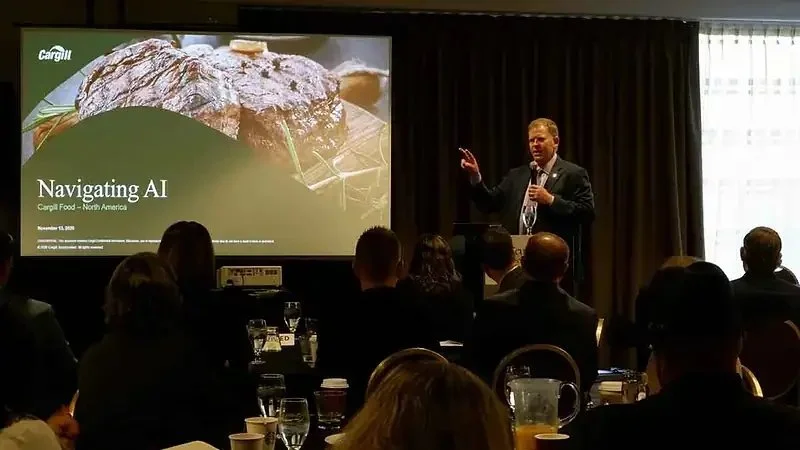
Speaking at the Ag Business Council’s November Breakfast Meeting, held in conjunction with Agriculture Future of America’s (AFA) Leaders Conference, Jarrod Gillig, Senior Vice President of Cargill’s North American Beef business, noted that Cargill adopted artificial intelligence into its meat processing operations several years ago. The goal was to increase protein yield from meat processing. Early on, Cargill contracted AI specialists, some of whom had little or no knowledge of the meat industry. “We would get different answers for the same problems from different contractors,” Gillig said. “There were so many questions and assumptions.”
So, Cargill brought in a group of data and technology specialists to work with its plant operations team to develop an in-house, proprietary solution utilizing an AI-powered “vision system” known as CarVe. In less than two years, it has demonstrated benefits beyond yield improvement, including waste reduction, thanks to cameras that monitor cutting performance and provide real-time feedback designed to improve both safety and efficiency. Early estimates from testing at Cargill facilities indicate the technology has increased yield by 0.5% per carcass.
One key area for AI is ingredient formulation and sensory optimization, where predictive modeling helps teams understand how ingredients behave across applications, consumer segments and markets. By integrating sensory science with AI and ingredient and component models, it can predict preference, reduce reformulation cycles, and work on innovations that help meet expectations around taste, texture and familiarity—which is critical for repeat purchase.
Another major area is process development and manufacturing, where digital tools support faster scale-up and more reliable production. AI-enabled inspection, simulation and data analytics allow teams to identify risks earlier, optimize processes and move from pilot to industrial scale with greater confidence. Here, model-based sensitivity analyses can be very effective.
AI is also increasingly important in connecting R&D with supply chains and sustainability considerations. By linking formulation choices with sourcing constraints, price volatility and environmental impact earlier in development, teams can design solutions that are not only innovative, but also scalable, affordable and resilient.
Sources: Jarrod Gillig, Senior Vice President of Cargill's North American Beef business (November 13, 2026); Renee Boerefijn, Ph.D., Cargill Research Director, AgFunderNews (January 16, 2026).