

Artificial Intelligence Takes Center Stage at 10th Annual Ag Innovation Forum
/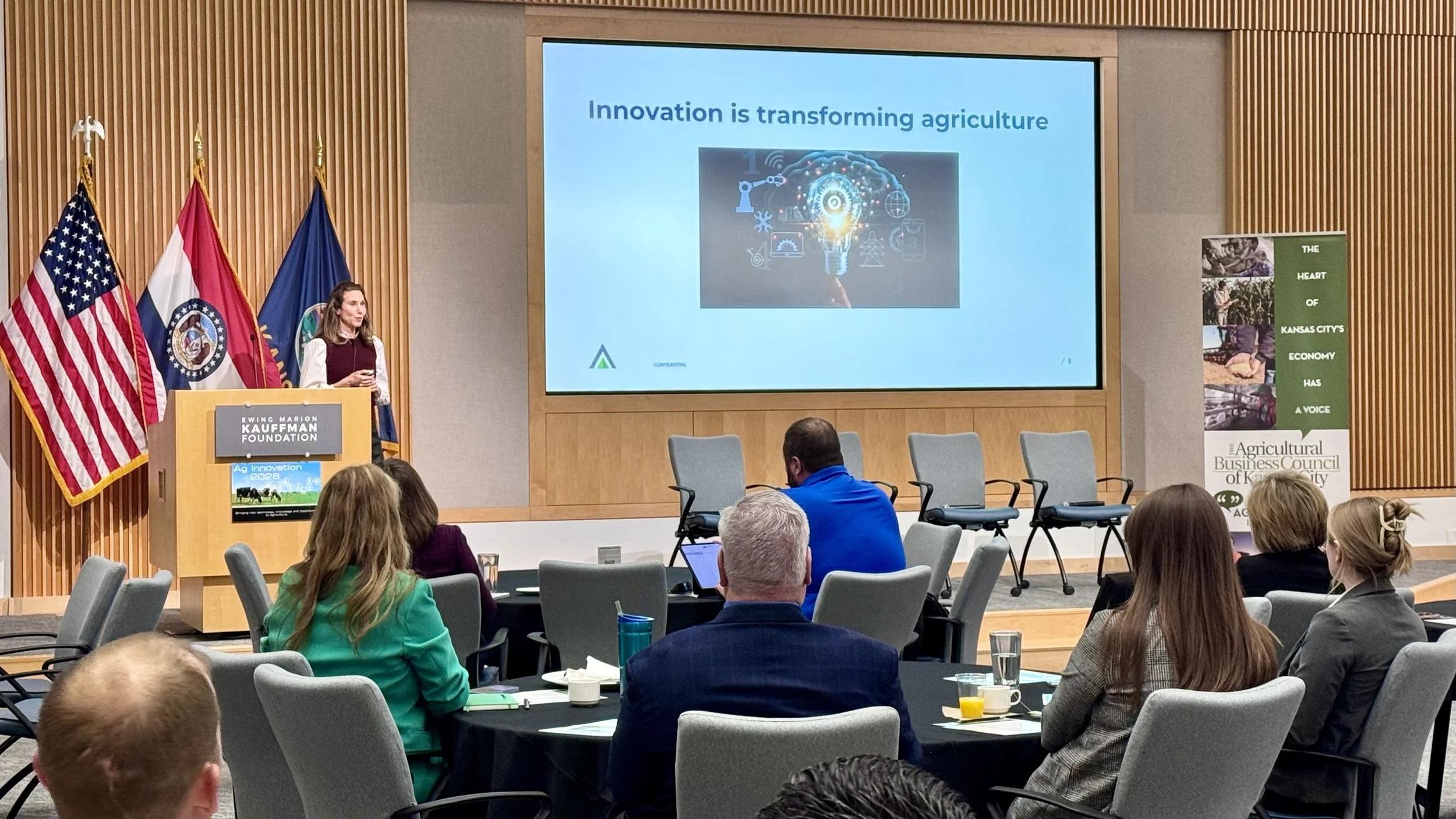
Contrary to current alarms surrounding AI, the keynote speaker at the 10th Annual Ag Innovation Forum, co-hosted by the Agricultural Business Council and the National Institute for Animal Agriculture, presented a composed overview and outlook for artificial intelligence technology. Elizabeth Fastiggi, chief product officer at Columbus, Ohio-based Idealyst Innovation, said, “AI is not to be feared, but to be collaborated with.” Regarding the question of whether AI is real or hype, she referred to Goldman Sachs’ recent forecast that AI would contribute $7 trillion to global GDP by 2033.
So, yes, it is real, and at an inflection point, said Fastiggi. Proliferation of data is de rigueur as AI approaches scalable compute capacity and machine learning innovation. AI is currently used in the business functions of 78% of organizations – up from 55% three years ago. “Generative AI focuses on creating content,” Fastiggi said. “But it lacks decision-making or action capability.” As AI further develops, she noted, businesses will soon be seeing advances such as AI Agents and Agentic AI.
AI Agents are software systems designed to act autonomously, observe their environment, reason, and execute tasks to achieve specific goals without continuous human supervision. They combine reasoning, planning, and memory to make informed decisions, adapt over time, and learn from interactions. AI Agents extend generative AI by enabling real-world interactions and task executions, Fastiggi explained.
Agentic AI concentrates on autonomous decision-making and action. It can set goals, plan and execute tasks with minimal human intervention. This emerging technology has the potential, noted Fastiggi, to revolutionize various industries by automating complex processes and optimizing workflows.
Practically Speaking
Fastiggi raised the broad question of whether AI would create a utopia or dystopia for farmers. As part of her answer, she referred to an insight from a recent comment from Christopher Waller, U.S. Federal Reserve Board of Governors, “The biggest gains won’t come from adding AI to existing processes,” he said. “They’ll come from rethinking workflows, roles and systems to take advantage of what this new technology makes possible.” The cultivation of food and goods through farm production has been practiced for some 13,000 years. During its brief history, agriculture has radically transformed human societies and propelled the global population over 8 billion people. Over that period, Fastiggi noted, the business of farming has often been overlooked and underserved. “But the future of our work is ours to build.”