
NAFB and AgBizKC Convene 2026 Summer Showcase
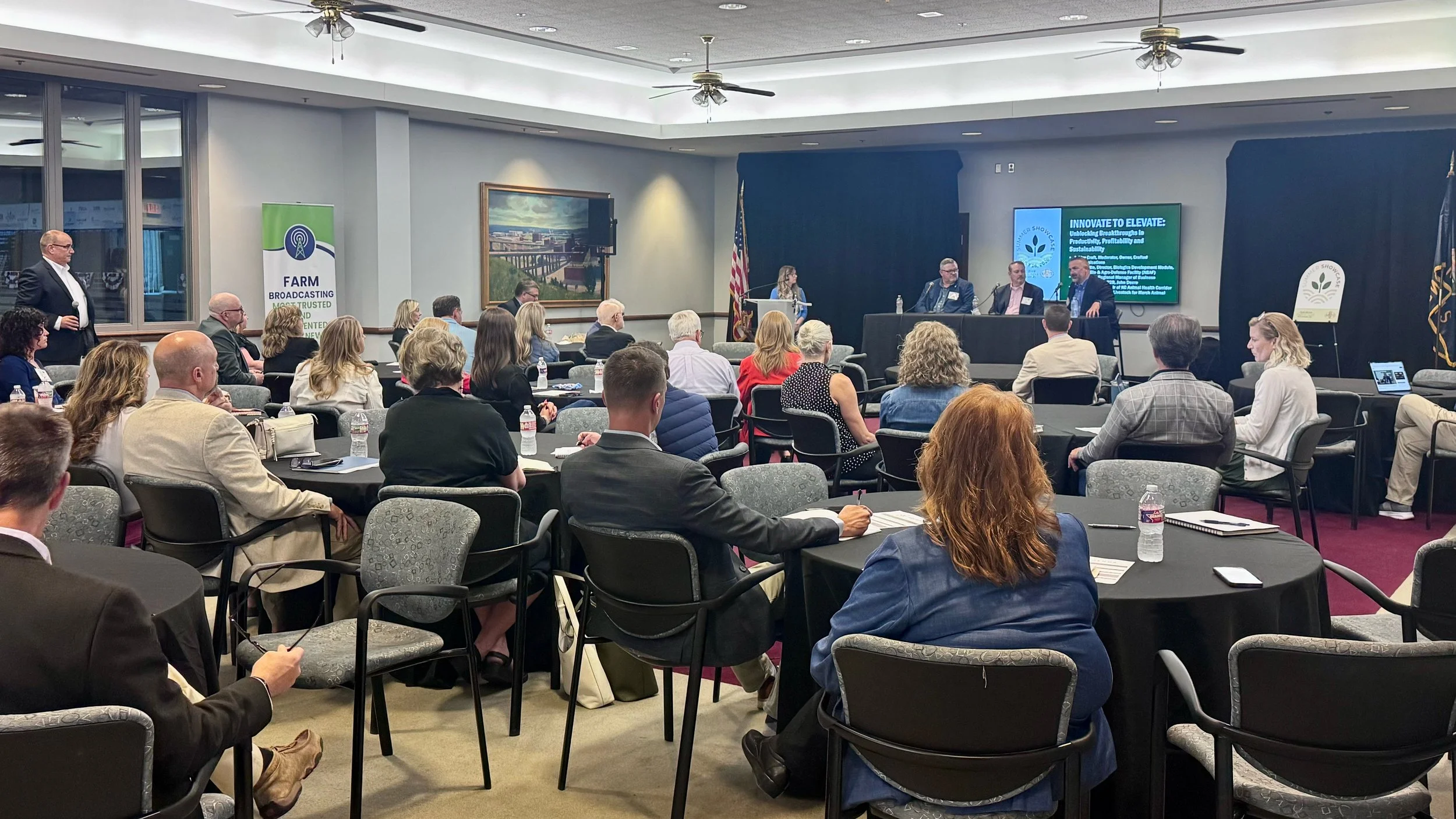
The National Association of Farm Broadcasting and the Ag Business Council’s joint gathering at the American Royal this month provided news and insights on emerging technologies, the dynamics of agricultural commodity prices, and the strengthening of safety and health services in rural communities. DeLoss Jahnke, NAFB president, opened the event noting that it was the first time NAFB had put on an event like this. “Who knew how it was going to turn out,” he said in his opening statements. Turns out, it was a timely and spot-on symposium.
The first panel discussion, Innovate to Elevate, featured insight and commentary by representatives from John Deere, the National Bio & Agro-Defense Facility, and Merck Animal Health. Steve Witte, director of NBAF’s Biologics Development Module, said, “Our containment spaces are not fully operational yet, but there is still a lot of great research that's happening at NBAF. Due to our close proximity with our great partner, Kansas State University, and their Biosecurity Research Institute, we're able to do a lot.”
Brad Tolbert, John Deere’s Regional Manager of Business Development, pointed out that he is continually impressed by his company’s innovative research and development, such as its Sea & Spray™ system. “So I think when we look at innovations, we look at what is already in the market; and watching for what we could change to make them better.” Tolbert noted that autonomous tractors could alleviate farmers’ labor stress.
Shannon Kellner, vice president of livestock at Merck Animal Health and Chair of KC Animal Health Corridor, explained that his company endeavors to apply technology, hardware, software, and data management to drive its diagnostics. “We are applying these tools and concepts to food production agriculture using animal monitoring, identification, and the ability to move information up and down the value chain more than we ever have.” Kellner noted the sooner a problem can be detected, the sooner a treatment can be developed. He added that food security is national security.
Participants in the Markets in Motion panel agreed that no one ever “accused the ag markets of being stable.” Mark Hobrock, senior vice president at The Andersons, said, “Guys, it’s heating up as each country bombs ships, elevators and export facilities.”
The panel determined that this destruction or disruption would solidify Russia’s position as the residual supplier of wheat to the world, while North America would be the residual supplier of corn and South America would be the residual supplier of soybeans.
The panel also addressed how all this overseas commotion was affecting U.S. commodity producers back on the farm, and concluded that farmers must have a risk management plan at the farm gate. A lot of these producers know their cost of production today, but they're up against a wave of high input prices. They're up against rapidly changing commodity markets and input costs that used to take 30 days to show up. “Now,” one panelist quipped, “input price changes occur in 30 seconds.”
Megan Grebner, NAFB Foundation President and Broadcast Supervisor at Brownfield Ag News, moderated a special panel discussion on the Human Side of Agriculture. While farmers are widely recognized for their grit and being on the front lines of climate challenges and market volatility, Grebner noted, they often suffer emotionally and psychologically. These conditions have produced high suicide and depression rates.
Panelist Garrett Hawkins, a farmer and president of the Missouri Farm Bureau, outlined the predicament farmers and ranchers can get into. “We are problem solvers by nature,” he said. “There is always another fence to fix, another field to check, another calf to tend to, another bill to pay and another season already coming at us before the last one is finished.” He went on to say that farmers are fathers, husbands, sons, brothers, neighbors, friends, doers, fixers and are used to being counted on. “But too often, we carry burdens on our shoulders that most people never see.”
This particular NAFB/AgBizKC discussion was timely, coming on the heels of a U.S. Senate Resolution unanimously passed this summer “to create awareness for the unique challenges agricultural producers and workers face, such as weather unpredictability, labor intensity and shortages, farm succession, and fluctuating commodity and market prices, and to promote mental well-being and awareness for current and future agricultural producers and workers.”